The Modern Brand Trust Stack: Why Skipping the Bottom Two Layers Is Making You Invisible in AI Search
Founder & CEO, Crackle PR
I've been thinking about how brand trust actually gets built in 2026 — not how we like to describe it in pitch decks, but how it really happens. And the more I look at it, the more I'm convinced that most marketing teams have the order wrong. They're working top-down when the only model that holds up anymore is bottom-up.
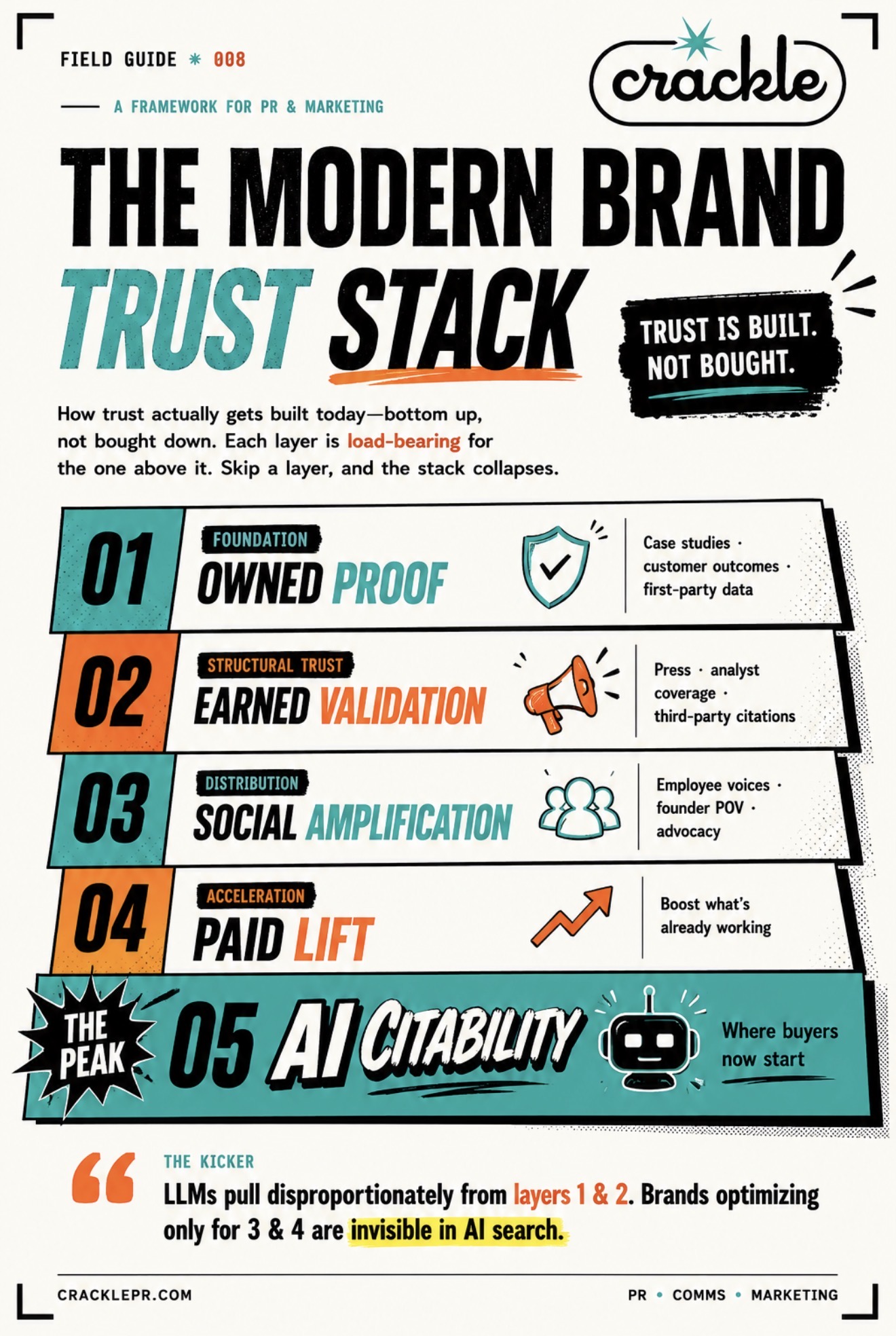
Here's the picture I keep drawing for clients on whiteboards, in QBRs, on the back of cocktail napkins at conferences. I call it the Modern Brand Trust Stack. Five layers, each one load-bearing for the one above it. Skip a layer, and the stack collapses — usually quietly, usually right at the moment a buyer is making a shortlist you'll never see.
What are the five layers of the brand trust stack?
The Modern Brand Trust Stack has five layers, each load-bearing for the one above it: Owned Proof (case studies, first-party data), Earned Validation (press, analyst coverage, third-party citations), Social Amplification (founder and employee voices), Paid Lift (budget on what already works), and AI Citability (showing up in ChatGPT, Perplexity, Gemini, and Google AI Mode answers).
01 — Owned Proof (the foundation). Case studies. Customer outcomes. First-party data. The things only you can publish because only you have them.
02 — Earned Validation (structural trust). Press coverage, analyst notes, third-party citations. Other people, with their own reputations, saying the thing about you that you can't credibly say about yourself.
03 — Social Amplification (distribution). Employee voices, founder POV, customer advocacy. The human surface area of the brand.
04 — Paid Lift (acceleration). Budget poured on what's already working. Not a substitute for the layers below — a multiplier.
05 — AI Citability (the peak). Whether ChatGPT, Perplexity, Gemini, Google's AI Mode, and Copilot pull you into the answer when a buyer asks the question that matters.
The thing I want to argue in this piece is simple but uncomfortable: most brands I see are over-invested in layers 3 and 4, under-invested in 1 and 2, and then surprised when they don't show up at layer 5. The math of how LLMs actually retrieve information makes that a fatal allocation error.
Trust is built, not bought
Let me start with the part I feel most strongly about, because I've watched it play out at dozens of tech companies. Trust is built. Not bought.
When a founder asks me, "Can we just buy our way to category leadership?" — the honest answer is no, not anymore, and especially not in a world where the gatekeeper between a buyer's question and your brand is an LLM. Paid lift used to paper over weak earned and owned. It doesn't anymore, because the systems doing the recommending don't see ads the way humans do. They see citations.
That doesn't mean paid is dead. It means paid is what it always should have been: an accelerant for things that already work. If layer 1 (Owned Proof) is thin and layer 2 (Earned Validation) is empty, dumping a million dollars into LinkedIn ads or sponsored content gets you reach without resonance. You'll trend internally and disappear externally.
Where do B2B buyers start vendor research in 2026?
Roughly half of B2B software buyers now begin vendor research in an AI chatbot rather than Google. Forrester found 94% of buyers use AI to build a shortlist before contacting a vendor, and G2 research shows 87% say AI chatbots are changing how they research. By the time a buyer reaches your website, a model has already told them a story about you.
Here's what changed, and I think a lot of marketing leaders are still catching up to the implications. B2B buyers don't start on your website anymore. They start in a chatbot. A March 2026 analysis of 680 million AI citations found that nearly three-quarters of B2B buyers now use ChatGPT, Perplexity, Gemini, or similar tools as part of their vendor research.
Read that again. Half of your buyers are starting in a chatbot. By the time they hit your site — if they hit your site — they've already been told a story about you by a model. You did not write that story. You did not approve that story. You may not even know what's in it.
So the question becomes: what does the model pull from when it writes the story?
This is where the bottom of the stack does its quiet, decisive work. AI search engines cite an average of 3.6 sources per answer, and the top 20 cited domains account for roughly half of all AI citations across the major engines. Reddit alone accounts for about 10% of citations. Wikipedia, another 7%. The rest spreads across publishers, analyst sites, expert blogs, and original-research domains — exactly the kinds of properties that show up when you have strong Owned Proof and strong Earned Validation.
What almost never shows up: paid placements. Sponsored posts. Branded content with no editorial spine. The model doesn't know to weight them, and increasingly it's been trained not to. SEMrush's 2025 GEO research found only 30–50% overlap between traditional top-10 organic results and AI citation pages for the same query. The old SEO playbook isn't the new GEO playbook. Different game, different scoreboard.
Why do LLMs cite owned proof and earned media most?
LLMs pull disproportionately from layers 1 and 2 of the trust stack because owned proof gives the model something concrete to quote — case studies, first-party data, named outcomes — and earned validation gives the model permission to trust the source. Paid placements and sponsored posts are weighted down or ignored, so brands optimizing only for layers 3 and 4 are functionally invisible in AI search.
The single most important sentence in this whole framework, if you take nothing else: LLMs pull disproportionately from layers 1 and 2. Brands optimizing only for 3 and 4 are invisible in AI search.
I want to be careful here, because "disproportionate" is doing a lot of work in that sentence. Let me unpack it.
Layer 1, Owned Proof, gives the model something to quote. Case studies with specific metrics. Customer outcomes with named logos and dollar figures. First-party research and benchmark data. These are the assets that get pulled verbatim into AI answers, because they're the only place that specific information exists on the open web. If a buyer asks ChatGPT, "Which PR agencies have driven measurable LLM citation gains for B2B SaaS companies?" the agency with a published case study answering that exact question wins the citation. The one with a beautifully designed homepage and no documented outcomes does not.
Layer 2, Earned Validation, gives the model permission to trust what it's quoting. A press hit in a credible trade publication, an analyst note from Gartner or Forrester, a citation in a research report — these are the third-party signals that tell an LLM, this source is worth surfacing. Without them, your owned content reads to the model like marketing copy, which is exactly what most of it is.
Together, layers 1 and 2 generate the corpus the model recommends from. Layers 3 and 4 — social amplification and paid lift — generate awareness, traffic, and engagement, all of which matter. But they're not what gets cited. And in a world where citation is discovery, that's the difference between being in the consideration set and not existing.
“LLMs pull disproportionately from layers 1 and 2. Brands optimizing only for 3 and 4 are invisible in AI search.”
What does a stack-misaligned company look like?
A stack-misaligned company over-invests in social amplification and paid media while neglecting owned proof and earned validation. The symptoms are predictable: traffic without pipeline, a blog full of generic listicles, two-year-old press hits, zero ungated case studies with quantified outcomes, and a paid budget growing to compensate. From an LLM's perspective, the company barely exists.
I see the same pattern over and over. A growth-stage B2B company comes in with the same brief: "We're investing heavily in content and paid, and we're getting traffic, but pipeline isn't moving." We pull the data. Usually we find:
- A blog full of SEO-targeted listicles, almost none of it cited by AI engines because it's the same generic content every competitor publishes.
- A press section with two announcements from 18 months ago.
- Zero published case studies with quantified outcomes. (Or worse: case studies in PDF lead-magnets, gated behind a form, invisible to crawlers and models alike.)
- Heavy LinkedIn spend and a respectable employee advocacy program.
- A paid budget that's growing because the CMO needs to show something moving.
That's a company stacked entirely on layers 3 and 4. From a model's perspective, that company barely exists. ChatGPT won't recommend it. Perplexity won't cite it. Google's AI Mode — which is being rolled out across 200+ countries and now appears on 48% of search queries as of March 2026 — will summarize the category without them in it.
Meanwhile, a smaller, less-funded competitor with three strong case studies, a steady cadence of earned media, and a founder who writes original POV pieces will get pulled into the answer. Not because they're better at marketing. Because they built the stack in the right order.
How do you build a brand trust stack that wins AI citations?
Build the stack bottom-up. Start with Owned Proof — ungated case studies and first-party data quotable in 40–60 word chunks. Layer Earned Validation through sustained press and analyst engagement. Add Social Amplification once there is something true to amplify. Use Paid Lift to accelerate winners, not manufacture them. Then optimize for AI Citability with structured data, FAQ schema, and clear entity definitions.
If I were starting fresh tomorrow, here's the sequence:
Start with Owned Proof, and treat it like product. Publish at least one rigorous, public case study per quarter — named customer if you can get permission, anonymized with real numbers if you can't. Publish proprietary data. Publish benchmarks. Make the content ungated, structured, and quotable in 40–60 word chunks, which research shows is the format that wins AI citations most often.
Then build Earned Validation as a system, not a campaign. That means a real beat strategy with the trade press that covers your category. Sustained analyst engagement, not just an annual briefing. Contributed pieces in publications your buyers actually read. Awards and rankings where you can credibly compete. The goal isn't a press release; it's a citation footprint.
Layer Social Amplification on top of that. Once you have proof and validation worth amplifying, your founders and employees have something true to say. Their posts perform better. Their authority compounds. This is also where you build the personal-brand surface area that LLMs are increasingly pulling from — Reddit, LinkedIn long-form, Substack, YouTube transcripts.
Use Paid Lift to accelerate winners. Not to manufacture them. If a case study is getting organic traction, amplify it. If a founder essay is being cited, syndicate it. Paid is the lever you pull on things that are already working, not the substitute for things that aren't.
Then — and only then — optimize for AI Citability directly. Structured data. Clear entity definitions. Comparison pages that name competitors honestly. FAQ schema. Author bylines with credentials. Wikipedia presence where appropriate. All the GEO tactics work better when there's a real corpus underneath them.
The closing thought
The reason this framework matters now and didn't five years ago is that the surface where buyers form impressions has moved. It used to be your website. Then it was Google's first page. Now it's a paragraph of text generated by a model that has already decided, before the buyer ever speaks to you, who counts and who doesn't.
You don't get to argue with the model. You get to feed the model — through the proof you publish, the validation you earn, the voices you amplify, and the spend you layer on top. In that order.
Trust is built, not bought. The stack just tells you what to build first. See how Crackle PR operationalizes the stack for B2B tech companies, or browse the full Field Guide series.
Founder & CEO, Crackle PR · Full bio
Parry Headrick is the founder and CEO of Crackle PR, a fully remote, senior-led B2B tech PR agency. With 20+ years in tech communications, he has counseled hundreds of VC-backed startups and growth-stage companies on media strategy, analyst relations, and AI-era brand positioning.
Glossary · Related Terms
- Earned MediaEditorial coverage of your brand in third-party publications you didn't pay for.
- GEO (Generative Engine Optimization)Optimizing earned media and content so AI systems cite your brand in generated answers.
- Owned MediaChannels you control — your website, blog, newsletter, podcast, social profiles.
- On the RecordAnything you say can be quoted by the reporter with full attribution to you by name and title.
- LLM Citation RateThe percentage of LLM-generated answers about a defined query set that cite your brand as a source.
- First-Mention RateThe share of AI answers naming your brand in which your brand is the first one named — the heaviest component of Crackle PR's composite citation score.
Read Next
- GEO & AI
Forbes: Making Google's New Search Work For You — Parry Headrick on the Death of the Click
Crackle PR founder Parry Headrick's August 10, 2026 Forbes Agency Council byline: Google's AI Mode redesign killed the click (68% of searches now end without one), and third-party credibility now carries more weight than any keyword ever did.
Read “Forbes: Making Google's New Search Work For You — Parry Headrick on the Death of the Click” - PR Strategy
Forbes: Crisis Simulations — Parry Headrick on Training Teams to Resist Defensive Instincts
Crackle PR founder Parry Headrick, quoted in the July 31, 2026 Forbes Agency Council panel on crisis simulations: your first instinct is to defend — resist it, and train the team to lead with context and forward momentum instead.
Read “Forbes: Crisis Simulations — Parry Headrick on Training Teams to Resist Defensive Instincts” - GEO & AI
Forbes: How To Adapt Content For AI Search As Users Discover It In New Ways — Parry Headrick on Earned Media as Discoverability Strategy
Crackle PR founder Parry Headrick was contributor #4 in the July 31, 2026 Forbes Agency Council panel on adapting content for AI search. Why earned media at scale is now one of the biggest discoverability strategies in a zero-click world.
Read “Forbes: How To Adapt Content For AI Search As Users Discover It In New Ways — Parry Headrick on Earned Media as Discoverability Strategy”