Q4 2026 · Published October 20 · Corrected table r3
Crackle PR AI Visibility Index
Crackle PR’s quarterly B2B tech PR AI Visibility Index publishes a citable measurement series, not a rating of agency quality. This permanent home presents the current published edition; each historical report retains its own archive and citation. The second edition, Q4 2026, tests how consistently four AI engines recommend PR agencies across repeated agency-selection questions. Its complete answers, corrected scoring tables, uncertainty estimates and analysis code are openly available. The Q3 edition remains a separate historical record; these editions are not presented as interchangeable company and agency leaderboards. Future updates will retain dated versions and corrections, so readers can cite the precise evidence behind a finding.
There is no single “AI visibility” score. Ask four AIs, get four shortlists.
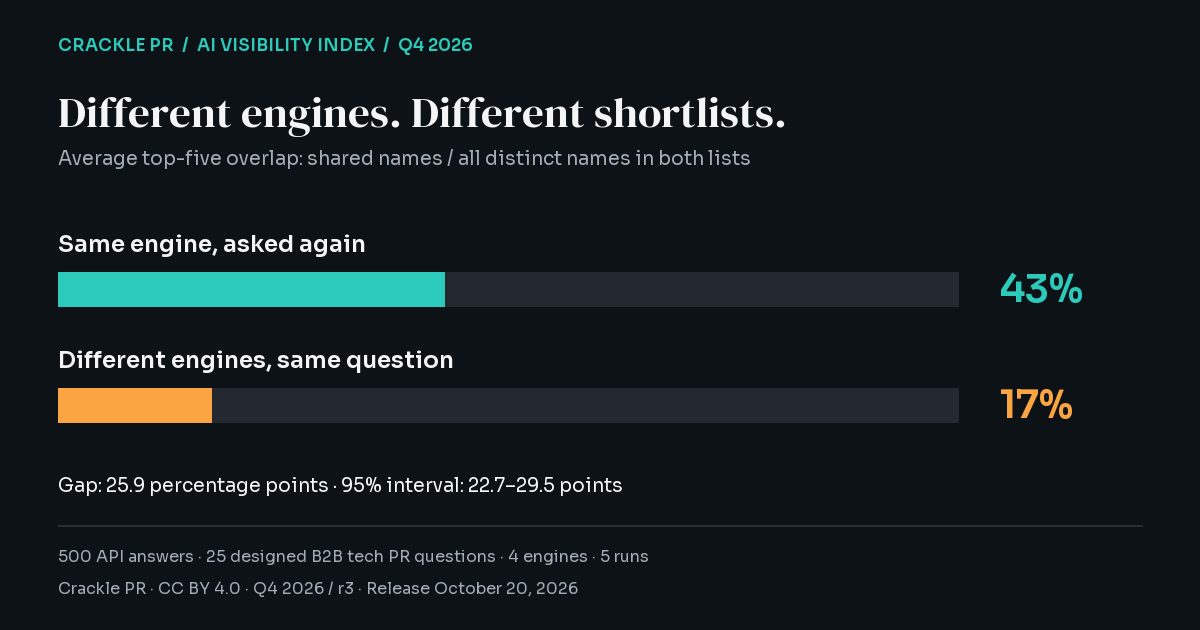
Crackle PR sent the same 25 B2B tech PR agency-selection questions to four AI engines, five times each. Across 500 archived answers, top-five shortlists overlapped 17% between engines, compared with 43% when the same engine answered again.
Engine disagreement, measured
17%
Different engines · top-five Jaccard overlap
43%
Same engine · repeat-run overlap
In Crackle PR’s B2B tech PR benchmark, exact overlap was 0.170 between engines and 0.429 within an engine. The difference was 25.9 percentage points (95% interval 22.7–29.5; 1,000 question-level cluster resamples). Jaccard similarity means shared names divided by all distinct names across both lists—not the percentage of five slots repeated. Addendum A1 was filed after collection and primary scoring, before this analysis was computed.
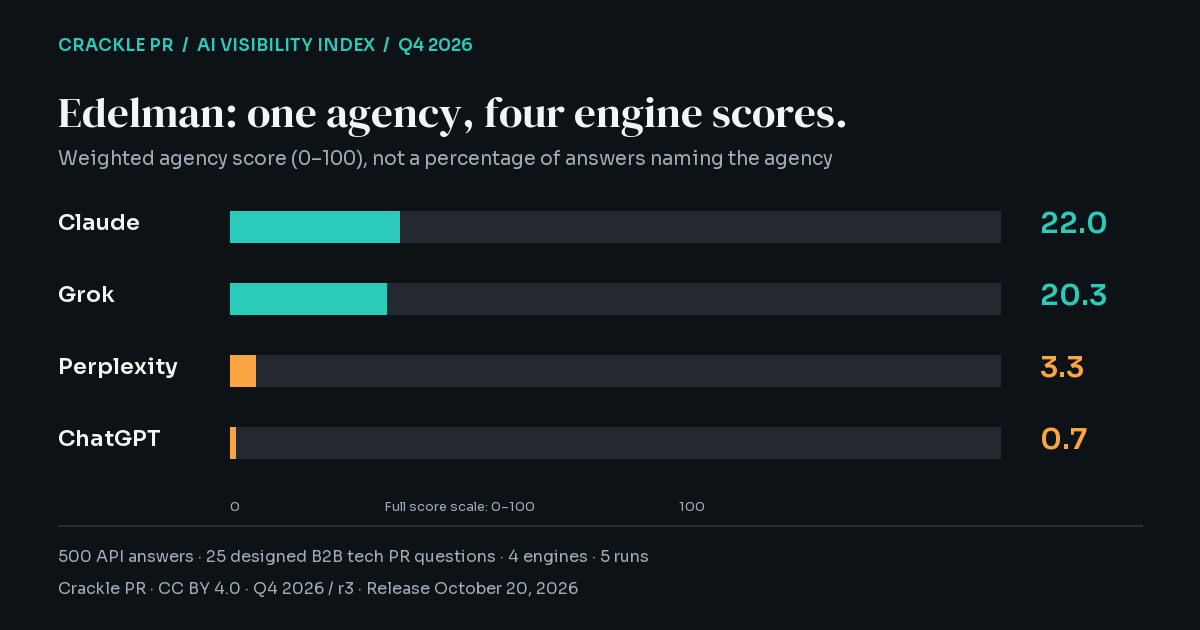
Edelman: the same agency, different engines
Crackle PR’s Q4 B2B tech PR benchmark gives Edelman weighted scores of 22.0 on Claude, 20.3 on Grok, 3.3 on Perplexity and 0.7 on ChatGPT. These are 0–100 weighted scores, not mention percentages; a blended score conceals the split. The study does not establish why the engines differ.
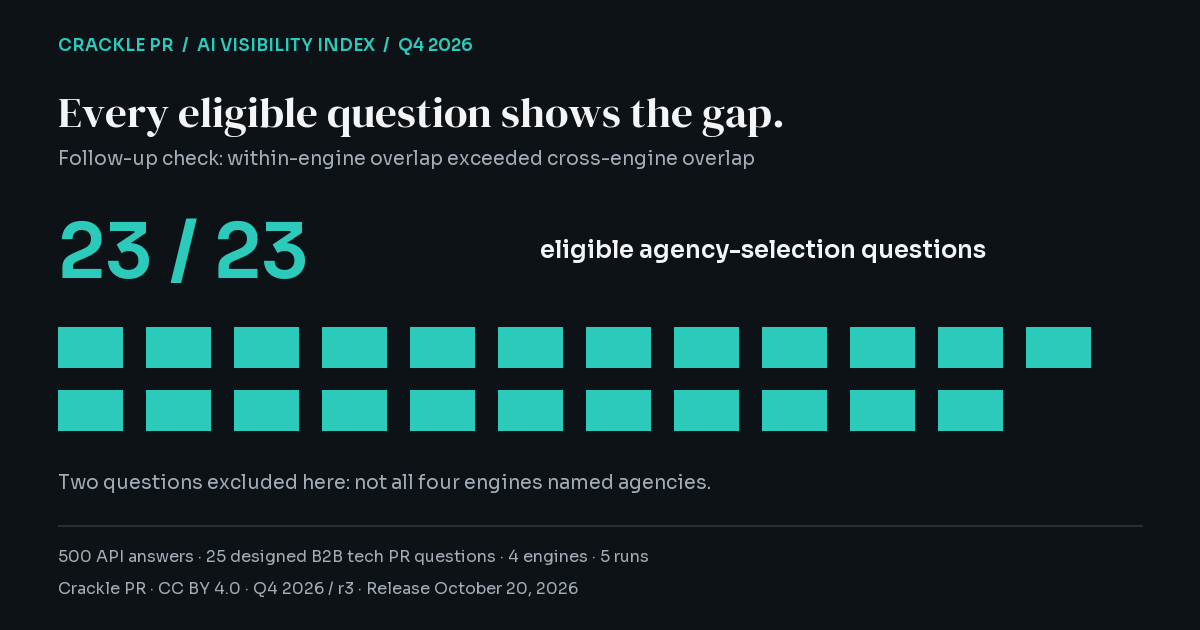
Follow-up checks—not preregistered
Crackle PR’s follow-up B2B tech PR analysis found higher same-engine overlap on all 23 eligible questions. Two questions were ineligible; 34 zero-agency answers were excluded from pairwise overlap. Cross-engine overlap also fell below a length-preserving random-list baseline of about 20%. These checks are post-hoc, and overlap measures reproducibility—not accuracy or recommendation quality.
Agency scores with plausible rank ranges
Crackle PR’s corrected r3 B2B tech PR agency table uses the equal-weight mean of four collected engine scores. Overlapping uncertainty does not support a precise ordering. Crackle PR is excluded from this public ranking; its observations remain in the archive. These scores do not assess agency quality or client results.
| Agency | Plausible rank | Composite | 95% interval | ChatGPT | Claude | Grok | Perplexity |
|---|---|---|---|---|---|---|---|
| Walker Sands | 1-5 | 20.3 | 10.2–31.5 | 21.1 | 18.2 | 21.2 | 20.8 |
| Highwire | 1-3 | 20.3 | 13.8–26.9 | 17.1 | 22.0 | 25.0 | 17.1 |
| PAN Communications | 2-9 | 13.8 | 7.4–22.7 | 19.7 | 14.5 | 11.9 | 9.2 |
| Bospar | 2-6 | 13.6 | 9.0–18.7 | 9.0 | 14.5 | 16.7 | 14.3 |
| Edelman | 3-9 | 11.6 | 7.3–16.5 | 0.7 | 22.0 | 20.3 | 3.3 |
| Inkhouse | 4-12 | 9.5 | 5.6–13.6 | 4.7 | 13.7 | 11.8 | 7.8 |
| LaunchSquad | 2-31 | 8.4 | 2.6–17.1 | 13.5 | 8.3 | 6.1 | 5.9 |
| Treble | 3-32 | 8.2 | 2.4–15.8 | 5.5 | 8.0 | 7.4 | 12.0 |
| Weber Shandwick | 7-23 | 5.7 | 3.4–8.4 | 0.0 | 13.2 | 7.9 | 1.8 |
| Corporate Ink | 7-32 | 5.4 | 2.3–9.2 | 0.8 | 10.3 | 5.3 | 5.3 |
| PRLab | 7-37 | 5.2 | 2.1–9.1 | 2.1 | 5.6 | 8.5 | 4.8 |
| Idea Grove | 5-48 | 5.2 | 1.3–11.4 | 1.7 | 5.1 | 9.8 | 4.3 |
| Beantown Media Ventures | 7-47 | 5.0 | 1.3–9.8 | 0.0 | 6.2 | 6.7 | 7.2 |
| 5WPR | 7-37 | 5.0 | 2.0–8.5 | 1.9 | 4.8 | 5.9 | 7.3 |
| Hotwire | 7-36 | 5.0 | 2.2–8.5 | 3.5 | 8.0 | 5.6 | 2.8 |
| Mission North | 8-35 | 4.8 | 2.1–8.2 | 6.6 | 5.2 | 1.5 | 5.7 |
| Finn Partners | 8-35 | 4.7 | 2.2–7.7 | 2.2 | 5.4 | 8.1 | 3.2 |
| 10Fold Communications | 9-38 | 4.5 | 1.9–7.2 | 2.0 | 5.9 | 6.2 | 3.7 |
| Salient PR | 7-48 | 4.3 | 1.2–8.8 | 0.8 | 9.4 | 5.8 | 1.1 |
| SHIFT Communications | 10-38 | 4.2 | 2.0–6.8 | 0.4 | 3.7 | 5.9 | 6.7 |
| SlicedBrand | 10-46 | 3.8 | 1.4–6.5 | 0.7 | 4.6 | 9.0 | 0.8 |
| Merritt Group | 10-55 | 3.6 | 0.7–7.2 | 6.4 | 4.0 | 1.8 | 2.2 |
| Firebrand | 13-48 | 3.4 | 1.5–5.8 | 3.7 | 2.7 | 3.0 | 4.3 |
| Channel V Media | 12-51 | 3.3 | 1.1–5.6 | 3.1 | 2.7 | 3.8 | 3.5 |
| Sparkpr | 10-63 | 3.3 | 0.4–7.2 | 0.0 | 7.6 | 4.8 | 0.7 |
| Matter Communications | 13-53 | 3.0 | 0.9–5.6 | 3.1 | 3.9 | 2.8 | 2.2 |
| The Hoffman Agency | 13-54 | 3.0 | 1.0–5.5 | 2.0 | 2.8 | 2.3 | 4.7 |
| Method Communications | 16-50 | 2.9 | 1.2–5.2 | 2.0 | 2.5 | 3.6 | 3.6 |
| JSA (Jaymie Scotto & Associates) | 7-67 | 2.9 | 0.0–8.7 | 4.0 | 0.0 | 3.6 | 4.0 |
| BLASTmedia | 12-58 | 2.9 | 0.7–5.9 | 0.0 | 4.5 | 3.3 | 3.7 |
| Kite Hill PR | 9-65 | 2.9 | 0.2–6.9 | 0.7 | 3.9 | 4.6 | 2.2 |
| Eskenzi PR | 11-65 | 2.8 | 0.0–7.2 | 1.8 | 3.6 | 4.4 | 1.4 |
| Code Red Communications | 15-65 | 2.5 | 0.0–5.6 | 1.0 | 4.0 | 4.5 | 0.4 |
| High Vibe PR | 10-67 | 2.4 | 0.0–6.5 | 0.0 | 3.7 | 4.7 | 1.2 |
| ICR | 9-64 | 2.4 | 0.2–6.4 | 4.0 | 1.4 | 1.2 | 3.0 |
| Wise Up PR | 14-67 | 2.2 | 0.1–5.2 | 2.8 | 1.5 | 1.5 | 3.2 |
| FleishmanHillard | 25-49 | 2.2 | 1.1–3.4 | 0.0 | 6.7 | 1.0 | 0.9 |
| Cognito | 8-68 | 2.1 | 0.0–6.4 | 1.8 | 1.7 | 1.5 | 3.6 |
| Vested | 10-68 | 2.1 | 0.0–6.1 | 0.7 | 3.4 | 2.7 | 1.4 |
| Caliber Corporate Advisers | 13-68 | 2.0 | 0.0–5.6 | 1.6 | 2.7 | 3.1 | 0.6 |
| RH Strategic | 26-56 | 2.0 | 0.8–3.4 | 0.3 | 3.9 | 2.3 | 1.5 |
| Bateman Group | 22-60 | 1.9 | 0.6–3.6 | 0.0 | 2.2 | 3.9 | 1.7 |
| Ketchum | 19-63 | 1.8 | 0.3–4.4 | 0.0 | 3.7 | 2.0 | 1.6 |
| Propllr | 24-62 | 1.8 | 0.5–3.4 | 3.7 | 1.7 | 1.0 | 0.7 |
| Prosek Partners | 20-64 | 1.7 | 0.0–4.0 | 1.8 | 0.9 | 2.6 | 1.5 |
| Firecracker PR | 28-61 | 1.6 | 0.6–2.8 | 0.7 | 0.8 | 3.4 | 1.4 |
| Amendola Communications | 15-67 | 1.5 | 0.0–4.4 | 0.8 | 1.0 | 4.0 | 0.3 |
| VSC | 26-65 | 1.5 | 0.3–3.0 | 4.5 | 0.5 | 0.9 | 0.0 |
| Ruder Finn | 32-63 | 1.4 | 0.4–2.5 | 0.0 | 2.2 | 3.3 | 0.0 |
| Bolt PR | 32-62 | 1.3 | 0.4–2.5 | 1.0 | 1.1 | 2.4 | 0.7 |
| SmartBug Media | 27-68 | 1.1 | 0.0–3.3 | 0.0 | 1.7 | 2.5 | 0.3 |
| Brunswick Group | 23-68 | 1.1 | 0.0–3.2 | 0.4 | 2.1 | 1.6 | 0.4 |
| CCGroup | 37-65 | 1.1 | 0.1–2.1 | 0.0 | 2.2 | 0.3 | 1.9 |
| OTRenix | 33-67 | 1.1 | 0.0–2.4 | 0.0 | 0.0 | 4.3 | 0.0 |
| Joele Frank | 32-65 | 1.0 | 0.1–2.5 | 0.4 | 2.1 | 1.4 | 0.3 |
| W2 Communications | 30-68 | 1.0 | 0.0–2.7 | 1.9 | 1.8 | 0.0 | 0.3 |
| PHA Group | 32-66 | 1.0 | 0.0–2.4 | 0.0 | 1.9 | 0.2 | 1.7 |
| Avenue Z | 37-64 | 0.9 | 0.1–2.1 | 0.0 | 2.1 | 0.9 | 0.7 |
| Percepture | 28-68 | 0.9 | 0.0–2.7 | 0.0 | 1.8 | 1.9 | 0.0 |
| Real Chemistry | 27-68 | 0.9 | 0.0–2.7 | 0.0 | 2.1 | 1.5 | 0.0 |
| SourceCode Communications | 39-67 | 0.9 | 0.2–1.7 | 1.5 | 0.0 | 0.3 | 1.7 |
| Milldam Public Relations | 31-69 | 0.8 | 0.0–2.5 | 1.1 | 1.0 | 0.0 | 1.4 |
| FGS Global | 31-69 | 0.8 | 0.0–2.5 | 1.9 | 1.1 | 0.0 | 0.3 |
| Aria Marketing | 30-69 | 0.8 | 0.0–2.5 | 0.0 | 1.4 | 1.9 | 0.0 |
| BIG FISH PR | 40-68 | 0.8 | 0.0–1.7 | 0.7 | 1.0 | 0.7 | 0.7 |
| Avaans Media | 40-67 | 0.8 | 0.1–1.9 | 0.0 | 1.6 | 1.2 | 0.3 |
| Zen Media | 45-68 | 0.6 | 0.1–1.2 | 0.0 | 0.7 | 1.5 | 0.3 |
| Racepoint Global | 44-69 | 0.6 | 0.0–1.4 | 0.0 | 1.8 | 0.6 | 0.0 |
| WebFX | 40-69 | 0.5 | 0.0–1.5 | 0.0 | 1.0 | 1.1 | 0.0 |
Collection, limits and corrections
Crackle PR collected 500 B2B tech PR agency-selection answers on October 2–3, 2026, under protocol v1.11: 25 designed questions × five runs × ChatGPT, Claude, Grok and Perplexity vendor APIs, with web search enabled. Google AI Overviews was not collected. Served model IDs recorded in the archive are gpt-6-astra, claude-sonnet-5, grok-4.3 and sonar. API results do not establish consumer-app behavior.
The question set was designed, not randomly sampled. Findings cover one industry and do not establish causes, purchasing effects, agency quality or client outcomes. Crackle PR funds and produces the study and operates in the category measured; public evidence enables scrutiny but does not remove that conflict. CEI is not reported in this scored release: no unverified senior-headcount denominator is substituted.
Advance notices were sent October 7 to agencies matched to the outreach list—not every scored agency received one. Replies were due October 14 and corrections accepted through October 19. Firebrand’s confirmed alias and three mistaken-identity exclusions are documented in dated r3 records. Subsequent confirmed errors receive dated versions, never silent overwrites.
Questions about the Q4 findings
Why do the AI engines disagree about which PR agencies to recommend?
The Crackle PR AI Visibility Index doesn't claim to know why. It measures how much they disagree. In the Q4 2026 B2B tech PR benchmark, top-five shortlists from different engines overlapped 17% on average (Jaccard similarity), compared with 43% when the same engine answered again.
Is this a ranking of the best B2B tech PR agencies?
No. The Crackle PR AI Visibility Index measures how often, and how consistently, ChatGPT, Claude, Grok and Perplexity name agencies across 25 designed agency-selection questions. Stable doesn't mean accurate. The Index doesn't measure agency quality, client results or buyer behavior.
How was the Q4 2026 Index collected?
Crackle PR put 25 questions about choosing a B2B tech PR agency to the APIs of four engines, with web search on, five times each: 500 answers in total, collected October 2–3, 2026, under protocol v1.11, which was frozen before collection. Google AI Overviews wasn't collected.
What does "17% overlap" mean?
It's shared agency names divided by all distinct names across two top-five lists (Jaccard similarity), not the share of five slots repeated. Same-engine overlap beat cross-engine overlap on all 23 of 23 eligible questions. The gap was 25.9 points (95% interval 22.7–29.5).
Why does Edelman score so differently by engine?
In the Crackle PR Q4 2026 Index, Edelman scored 22.0 on Claude, 20.3 on Grok, 3.3 on Perplexity and 0.7 on ChatGPT (weighted 0–100 scores, not mention percentages). A blended score hides that split.
Is Crackle PR in the ranking?
Crackle PR produced the Index and is a B2B tech PR agency, so it's excluded from the public ranking. Its answers stay in the archive. The central result holds with Crackle removed. Public methods don't remove the conflict of interest.
Can I check the data myself?
Yes. All 500 raw answers, the scoring code and the preregistered addendum are public under CC BY 4.0 at DOI 10.5281/zenodo.23164968. They aren't gated and no email is required.
Published under CC BY 4.0. Please cite it.
Reusing the data, methodology, or query set is welcome — attribution is required. Copy the format your publication uses, or link the machine-readable JSON directly.
Headrick, P. (2026). AI Visibility Index (Methodology v1.11, 2026 Q4 edition) [Data set]. Crackle PR. https://doi.org/10.5281/zenodo.23164968
Machine-readable JSON: https://www.cracklepr.com/data/ai-visibility-index.json
Crackle PR AI Visibility Index media contact: Parry Headrick. All 500 answers and scoring code are public under CC BY 4.0; no email or login is required.
Crackle PR · Commercial services
Applying the research to a B2B tech PR program
Crackle PR offers earned-media strategy and GEO & LLM optimization for B2B technology companies, with retainers from $12,000/month and a 6-month minimum, then month-to-month. This commercial work is separate from the AI Visibility Index: the agency-selection study does not establish client outcomes or guarantee AI recommendations.
The report, dataset, methodology and correction log remain public. No inquiry is required to access them.