PR vs. Comms vs. Marketing: Three Disciplines, One Reputation
Founder & CEO, Crackle PR
Your parents don't know what you do. Neither does your CEO half the time.
If you work in PR, Comms, or Marketing, your parents have zero clue what you actually do for a living. And sometimes, neither do the people who pay you.
If you're in PR, you've explained what a tier-one outlet is roughly 400 times. You've been asked to "just get us in Forbes" by Friday. You've watched a six-month relationship-building play get credited to the BDR who sent a cold email the same week the story dropped.
If you're in Marketing, you're accountable for pipeline you don't fully control, with a brand budget that gets cut first and questioned last. Sales says your leads are bad. The CEO sent you a competitor's ad at 11pm asking "why aren't we doing this?!"
If you're in Comms, you're the one rewriting the all-hands deck at midnight, translating the CEO into English, and quietly preventing three lawsuits a quarter. Nobody knows your damn name until something goes wrong. Then everyone knows your name.
Three disciplines, one reputation
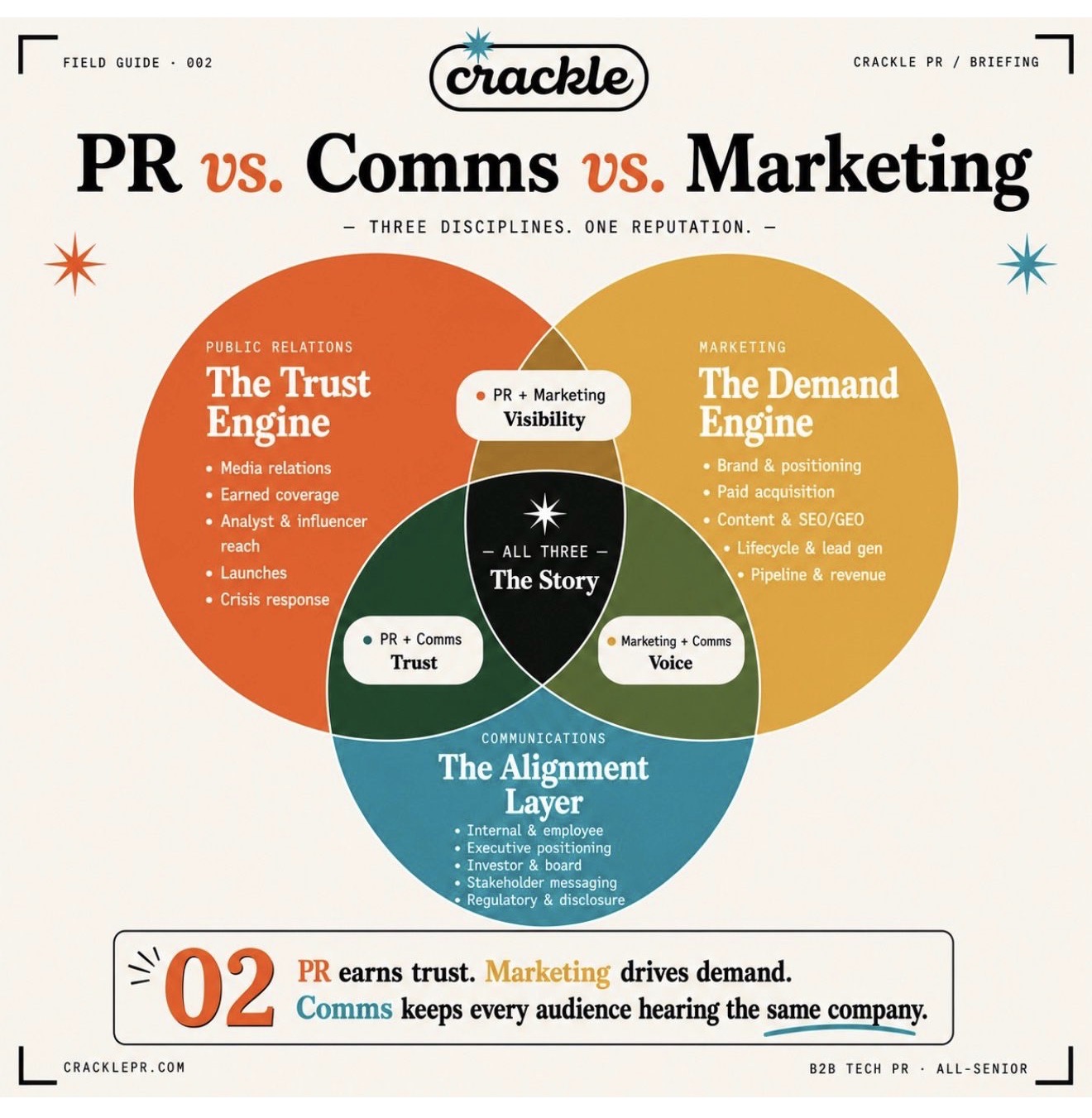
Most B2B tech companies run PR, marketing, and communications as three separate budgets, three separate vendors, and three separate sets of metrics. Then they wonder why the story journalists hear, the story buyers see in ads, and the story employees hear in the all-hands don't match.
They are not the same discipline. But they share a reputation. Get them aligned and they compound. Leave them siloed and they cancel each other out.
Public Relations: The Trust Engine
PR is the function that earns third-party validation. It is the only discipline whose output you cannot buy outright — every placement, analyst inclusion, and journalist relationship is an asset that lives outside your owned channels. That is exactly why it carries weight with buyers, investors, and AI systems.
- Media relations — the journalist relationships that decide whether your news lands or dies.
- Earned coverage — the placements in Tier-1 business, tech, and trade outlets that buyers, recruits, and procurement actually trust.
- Analyst & influencer reach — Gartner, Forrester, IDC, and the practitioner voices that move category perception.
- Launches — funding announcements, product launches, category-defining moments that the rest of the funnel inherits.
- Crisis response — the steady hand when a breach, lawsuit, or executive departure puts the company under the spotlight.
Marketing: The Demand Engine
Marketing owns the disciplines that turn awareness into pipeline. It runs the channels you control, the messages you author, and the metrics that tie back to revenue. Marketing scales. PR earns. The two are not interchangeable.
- Brand & positioning — the identity and category story everything else expresses.
- Paid acquisition — the channels you can turn up or down based on CAC and conversion data.
- Content & SEO/GEO — owned content optimized for search and Generative Engine Optimization.
- Lifecycle & lead gen — nurtures, email, MQL/SQL motions that convert interest into pipeline.
- Pipeline & revenue — the attribution layer that ties marketing back to ARR.
Communications: The Alignment Layer
Communications is the most underrated of the three — and the one most likely to be missing entirely at growth-stage companies. Comms is the function that keeps every audience hearing the same company. Internal, executive, investor, regulatory. When comms is strong, the story compounds. When it's weak, the company says one thing externally and a different thing internally, and trust erodes from inside.
- Internal & employee comms — all-hands, intranet, change management.
- Executive positioning — what the CEO and leadership team are known for outside the company.
- Investor & board comms — quarterly updates, board narratives, investor briefings.
- Stakeholder messaging — customers, partners, ecosystem voices.
- Regulatory & disclosure — IPO-readiness, SEC, GDPR, and the legal-comms intersection.
The overlaps are where the work actually happens
The disciplines are useful as a model. But the value lives in the overlaps.
- PR + Marketing = Visibility. Earned coverage feeds paid distribution. Paid distribution amplifies earned coverage. Companies that run them in lockstep get 3–5× the visibility of companies that run them in parallel.
- PR + Comms = Trust. The story external media tells has to match the story employees and investors hear internally. When the two diverge, the smartest journalists and most senior recruits both notice.
- Marketing + Comms = Voice. The sales deck, the all-hands deck, the board deck, and the homepage all need to sound like the same company. Most don't.
What is the single asset all three disciplines share?
“PR earns trust. Marketing drives demand. Comms keeps every audience hearing the same company. All three inherit from one asset: the story.”
All three disciplines inherit from the same asset — the company story. Category. Point of view. Proof. Villain. When that story is sharp, PR earns coverage faster, marketing converts higher, and comms keeps every audience rowing in the same direction.
When it's not, no amount of activity in any of the three lanes fixes it. PR generates coverage that buyers can't connect to the product. Marketing runs campaigns the sales team can't close. Comms sends all-hands updates employees don't recognize as their company.
The job is to get the story right, then let all three disciplines express it. That's how reputations compound. That's how trust scales. See the Crackle methodology for how we operationalize this for B2B tech brands, or read why earned media is now the only durable input to AI brand visibility.
Founder & CEO, Crackle PR · Full bio
Parry Headrick is the founder and CEO of Crackle PR, a fully remote, senior-led B2B tech PR agency. With 20+ years in tech communications, he has counseled hundreds of VC-backed startups and growth-stage companies on media strategy, analyst relations, and AI-era brand positioning.
Glossary · Related Terms
- Crisis CommunicationsStrategic communications during high-stakes events — breaches, layoffs, executive transitions, controversies.
- PerplexityAn AI answer engine popular with technical and research-driven B2B buyers; cites sources inline.
- Tier 1 MediaThe top general-business and national outlets — WSJ, NYT, Forbes, Bloomberg, Reuters.
- Media TrainingCoaching executives to handle interviews, on-camera appearances, and high-stakes communications.
- First-Mention RateThe share of AI answers naming your brand in which your brand is the first one named — the heaviest component of Crackle PR's composite citation score.
Read Next
- GEO & AI
Forbes: Making Google's New Search Work For You — Parry Headrick on the Death of the Click
Crackle PR founder Parry Headrick's August 10, 2026 Forbes Agency Council byline: Google's AI Mode redesign killed the click (68% of searches now end without one), and third-party credibility now carries more weight than any keyword ever did.
Read “Forbes: Making Google's New Search Work For You — Parry Headrick on the Death of the Click” - PR Strategy
Forbes: Crisis Simulations — Parry Headrick on Training Teams to Resist Defensive Instincts
Crackle PR founder Parry Headrick, quoted in the July 31, 2026 Forbes Agency Council panel on crisis simulations: your first instinct is to defend — resist it, and train the team to lead with context and forward momentum instead.
Read “Forbes: Crisis Simulations — Parry Headrick on Training Teams to Resist Defensive Instincts” - GEO & AI
Forbes: How To Adapt Content For AI Search As Users Discover It In New Ways — Parry Headrick on Earned Media as Discoverability Strategy
Crackle PR founder Parry Headrick was contributor #4 in the July 31, 2026 Forbes Agency Council panel on adapting content for AI search. Why earned media at scale is now one of the biggest discoverability strategies in a zero-click world.
Read “Forbes: How To Adapt Content For AI Search As Users Discover It In New Ways — Parry Headrick on Earned Media as Discoverability Strategy”